
Teqball is a sport that requires full body involvement. Players use their feet, knees, thighs, chest, and head to volley a soccer ball across a curved table. Of course, use of the hands is restricted as the sport is a combination of table tennis and football. Nonetheless, players are certainly encouraged to use their body as a physical bat.
By Matt Nelsen
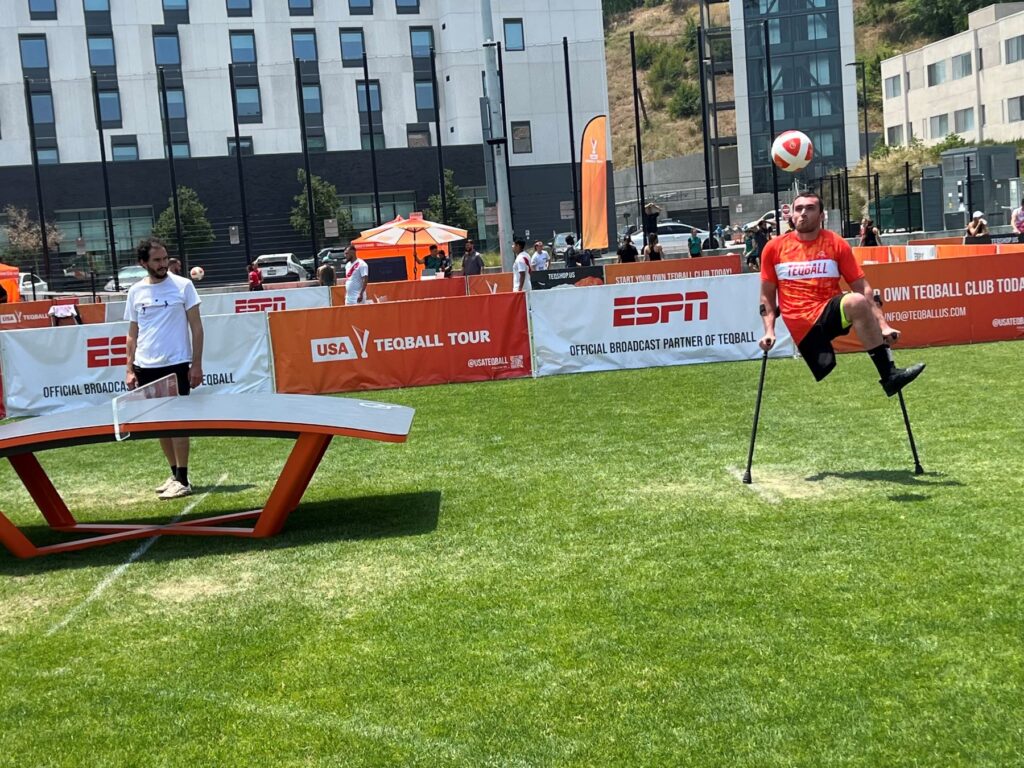
From afar, much of the play looks similar. Players serve the ball with their knees or feet. They dribble or pass the ball to their partners. The pair quickly delivers it over the clear net and to their opponents who try to keep the ball in play. All while adapting to the surface of play, whether it be grass, sand, or sports flooring.
In a sport of infinite possibilities, one player stands for his innovative play, Nicolai Calabria.
Calabria was born without a right leg. He serves the ball with his head, dribbles it with his left leg and thigh, and uses his crutches with impressive athletic ability to complete wondrous acrobatic strikes of the ball. “You have to have really good touch to play this game,” remarks Calabria. “It’s incredibly technical. I came in just thinking, ‘I’ll be good at this because I have good touch,’ but it’s a whole nother level.”
Calabria is no stranger to the soccer ball, let alone the pitch. The Massachusetts native has multiple caps at the Amputee Football World Cup, and is known as a prolific goal scorer. He also serves as captain of the U.S. Men’s Amputee Soccer Team. He described the sport as, “incredibly exciting,” adding, “it’s a lot of fun.” While amputee football enjoys the participation of dozens of countries across five regions, it has yet to find its way to the Paralympic Games. A fact Calabria hopes will change in the future.
Opportunity to play
“Disabled people want to compete and be seen as athletes as well,” explained a passionate Calabria. “We don’t want a pity story. We don’t want an inspiration story. We just want to have representation and an opportunity to play.” While amputee football distinguishes itself with the otherness of its players from its globally popular able-bodied cousin, teqball has been a platform of integration for the American. He entered the latest stop of the USA Teqball Tour with able-bodied partner, Mark Millan. The pair won two matches in group play, but failed to reach the knockout bracket. It was an admirable feat for Calabria though, considering it was only his second proper competition in the sport.
“I was in LA for an amputee soccer camp…and they had a teqball table there, I had seen it online, and I just went and messed around for a while. I started playing there and then I got to play in my first tournament in Los Angeles earlier this year. I went with my coach and neither of us had ever played competitively before,” explained Calabria. “It was just obvious we had no idea what we were doing, but it was super fun.” So fun, in fact, that Calabria decided it was worthwhile to take some time off from his day job teaching middle school social studies to travel to the competition in Los Angeles.
“I just love to compete,” admitted the football-crazed American. “I want to be an athlete. I want to find sponsorships and be able to do this full-time.” He has launched himself fully into the sport, aiding in an effort to develop para teqball.
“You got to see it to want to be it. If teqball is serious about wanting a para [sport] program, I think a marquee matchup is a really good place to start for visibility.”
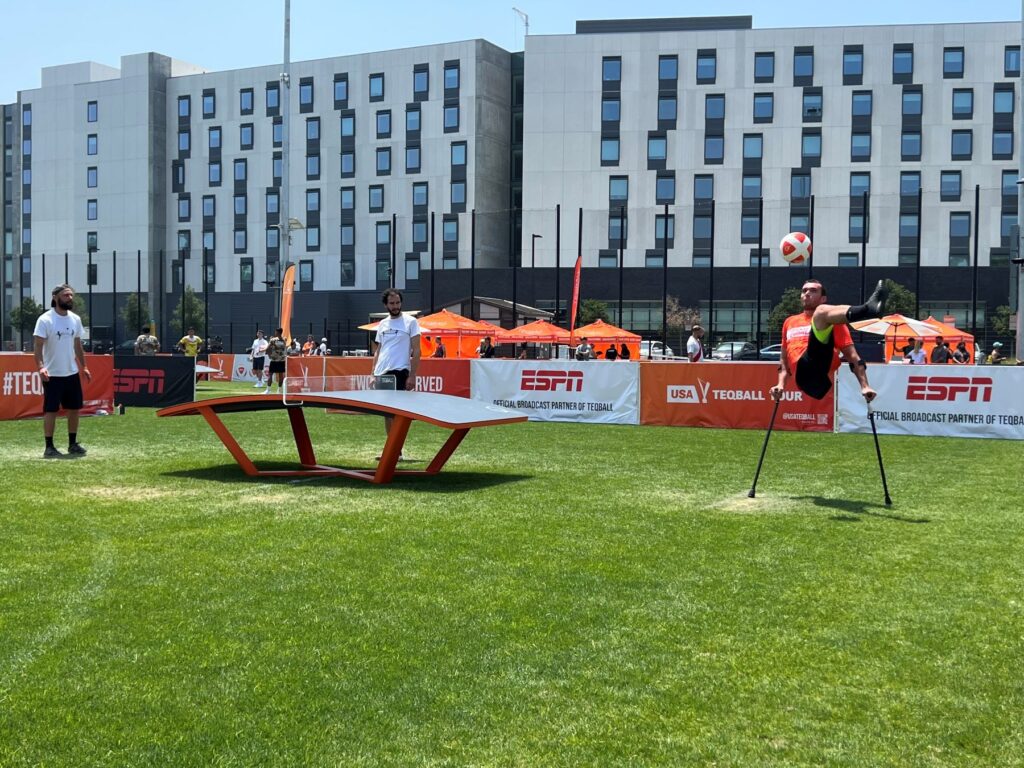
Integrated teams
He firmly believes integrated mixed doubles is the secret recipe to success. Under his proposal, a para teqer would be paired with an able-bodied teqer and compete against other similarly integrated teams. “So often disability sport is separate,” declared Calabria. “It’s on its own.” He said he understood why that is necessary to create a level playing field, but added, “there is something that is cool about sharing the space regardless of ability. Teqball seems like a really good example of where that can work.”
Still, discussions continue over the rules for para teqers. It has been proposed that para teqers may be allowed an extra bounce not afforded to able-bodied players. Calabria doesn’t see that as a positive development for the sport. “I don’t want to play with the bounce,” commented the American. “I think it’s a little sad.” Instead, he suggested some other rule variations to open the sport to para athletes. Calabria believes players should be allowed to use crutches and put one over the center line during play. Currently, players are forbidden from crossing the center line to strike the ball. He also admits a bounce may be needed in some circumstances to help para teqers dribble the ball or pass it to their partners.
Amputee soccer
Of course, none of that will matter if the sport can’t attract para athletes. Calabria stated: “People don’t even know that amputee soccer exists in the United States. I run into amputees all the time, and they don’t know it’s an option to play. Every year we find someone who has been playing soccer amongst able-bodied people as an amputee, and they don’t even know that there’s a sport where it’s a level playing field for them.”
He hopes his efforts will change that reality for para teqers. For now, he can only draw on past experience to inform the present. “Sport is a universal language; soccer particularly,” noted Calabria. “It removes barriers. It removes the language barrier. It removes the ableist barrier.” He’s seen its transformative powers first hand. From pick-up games in Zanzibar to integrated games in high school. Football has allowed him to excel, explore, and excite. He sincerely hopes teqball will allow him to do the same.